
Choosing the right beam saw directly affects production efficiency, material utilization, and long-term operating costs. Rather than comparing specifications alone, we recommend evaluating machine structure, automation, software compatibility, and after-sales support together.
This guide explains the essential considerations when selecting a beam saw for industrial applications.
Define Your Production Requirements Before Choosing a CNC Beam Saw
Every purchasing decision should begin with production analysis rather than machine comparison. Buyers should first evaluate the types of panels being processed, daily production volume, material dimensions, cutting thickness, and future expansion plans.
A machine that performs well for a medium-sized furniture factory may not be the best solution for a high-volume production line. Selecting equipment with suitable cutting capacity allows manufacturers to balance investment costs and productivity while avoiding excessive machine downtime.
We also recommend considering factory layout during equipment planning. Loading direction, material flow, and available installation space all influence production efficiency. A well-matched machine integrates smoothly into existing manufacturing processes instead of creating unnecessary handling steps.
Evaluate Cutting Accuracy and Machine Stability with a CNC Panel Saw
Stable mechanical construction is the foundation of cutting precision. During equipment selection, buyers should pay close attention to frame manufacturing rather than focusing only on cutting speed.
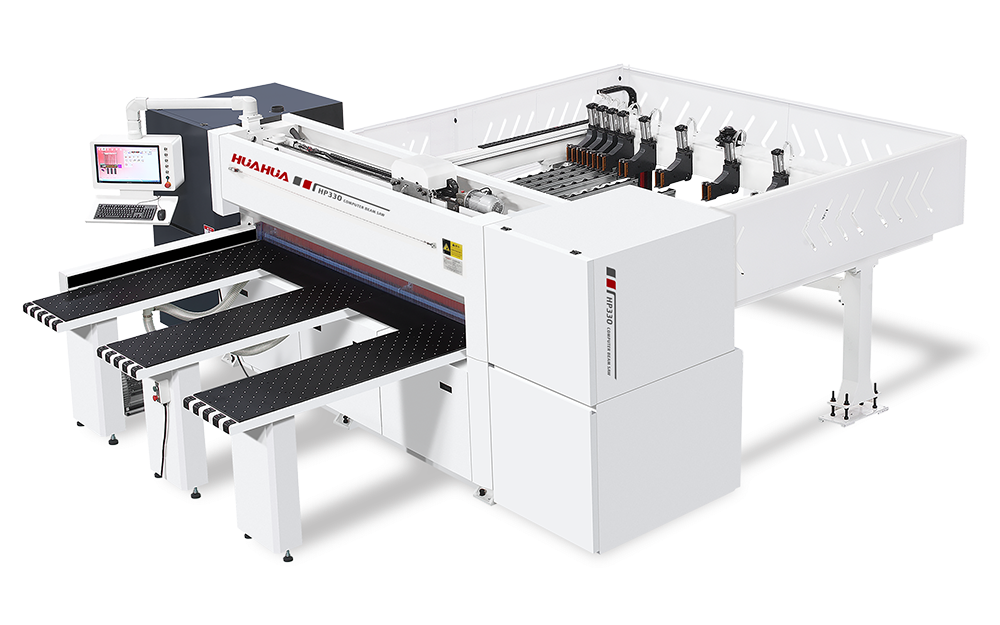
For example, the HUAHUA CNC HP330 adopts a heavy steel frame that undergoes stress relief treatment after welding and additional aging treatment before precision machining. This manufacturing process is intended to improve structural stability and reduce deformation during long-term operation.
Cutting precision also depends on stable workpiece transportation. The HP330 uses a pneumatic two-finger clamping structure that secures the panel during feeding while helping protect the panel surface from damage. Roller conveyors further support smooth material movement throughout the cutting process.
For buyers processing high-value decorative panels, stable feeding and accurate positioning often contribute more to finished product quality than simply selecting higher motor power.
Compare Automation and Control Functions of a CNC Beam Saw
Modern beam saws should simplify production management instead of adding operational complexity. Therefore, software capability deserves the same attention as mechanical configuration.
The HP330 is equipped with an industrial PC control system designed for manual editing, cutting plan simulation, and execution. The system also supports barcode management software and factory automation software, making it easier to integrate with existing manufacturing workflows.
When evaluating different suppliers, buyers should examine whether the control system provides clear operating guidance, troubleshooting functions, and compatibility with production management software. These features can reduce operator training time while improving production consistency.
Optional cutting optimization software may also provide additional value. Functions such as cutting layout optimization, automatic calculation, and remaining material management can improve panel utilization and support more efficient production planning.
Examine Mechanical Components in a CNC Panel Saw
Machine reliability depends on the quality of its major mechanical assemblies. Buyers should carefully review the feeding system, saw carriage, lifting mechanism, and drive components before making purchasing decisions.
On the HP330, the saw carriage is driven by a servo motor combined with reduction mechanisms to maintain efficient and stable movement. Independent lifting of the main saw and scoring saw allows the sawing stroke to adjust automatically according to different panel dimensions, reducing unnecessary movement during production.
The cutting bench also deserves attention. The HP330 incorporates an air-floating worktable with roller assistance to help operators move heavy panels more easily while reducing the risk of surface scratching. The upgraded table design also aims to improve support during cutting operations.
Instead of comparing isolated specifications, buyers should evaluate how these mechanical systems work together to provide consistent production performance over extended operating periods.
Consider Maintenance, Service, and Future Expansion for a CNC Beam Saw
Purchasing industrial equipment represents a long-term investment. The supplier’s technical support and machine expandability should therefore become part of the evaluation process.
Routine maintenance becomes easier when machines include accessible components, clear operating guidance, and standardized replacement procedures. Buyers should also verify the availability of spare parts and technical assistance before placing an order.
Future production requirements should also influence equipment selection. If factory output is expected to increase, choosing equipment that supports software integration or optional automation upgrades can reduce future modification costs.
We offer several CNC panel saw series with different configurations, allowing manufacturers to select equipment according to production scale rather than adopting a one-size-fits-all solution. The HP series includes models designed for different cutting capacities and production requirements.
Making a Practical Investment with HUAHUA CNC
Selecting the right beam saw requires balancing production requirements, machine stability, software capability, maintenance convenience, and supplier support. A purchasing decision based only on price or isolated specifications may not deliver the best long-term value.
At HUAHUA CNC, we focus on providing practical woodworking equipment designed for reliable industrial production. Our HP330 CNC beam saw combines a stable machine frame, industrial PC control system, pneumatic clamping, servo-driven saw carriage, and optional cutting optimization functions to support efficient panel processing.