
Cabinet manufacturing has evolved from isolated cutting operations into integrated production systems that connect design, machining, labeling, drilling, edge banding, and assembly. Choosing between a CNC nesting machine and a panel saw is therefore not simply a decision about cutting technology.
It is a decision that influences production flexibility, labor organization, software integration, and long-term manufacturing efficiency. We work closely with customers to compare these solutions according to their actual production objectives.
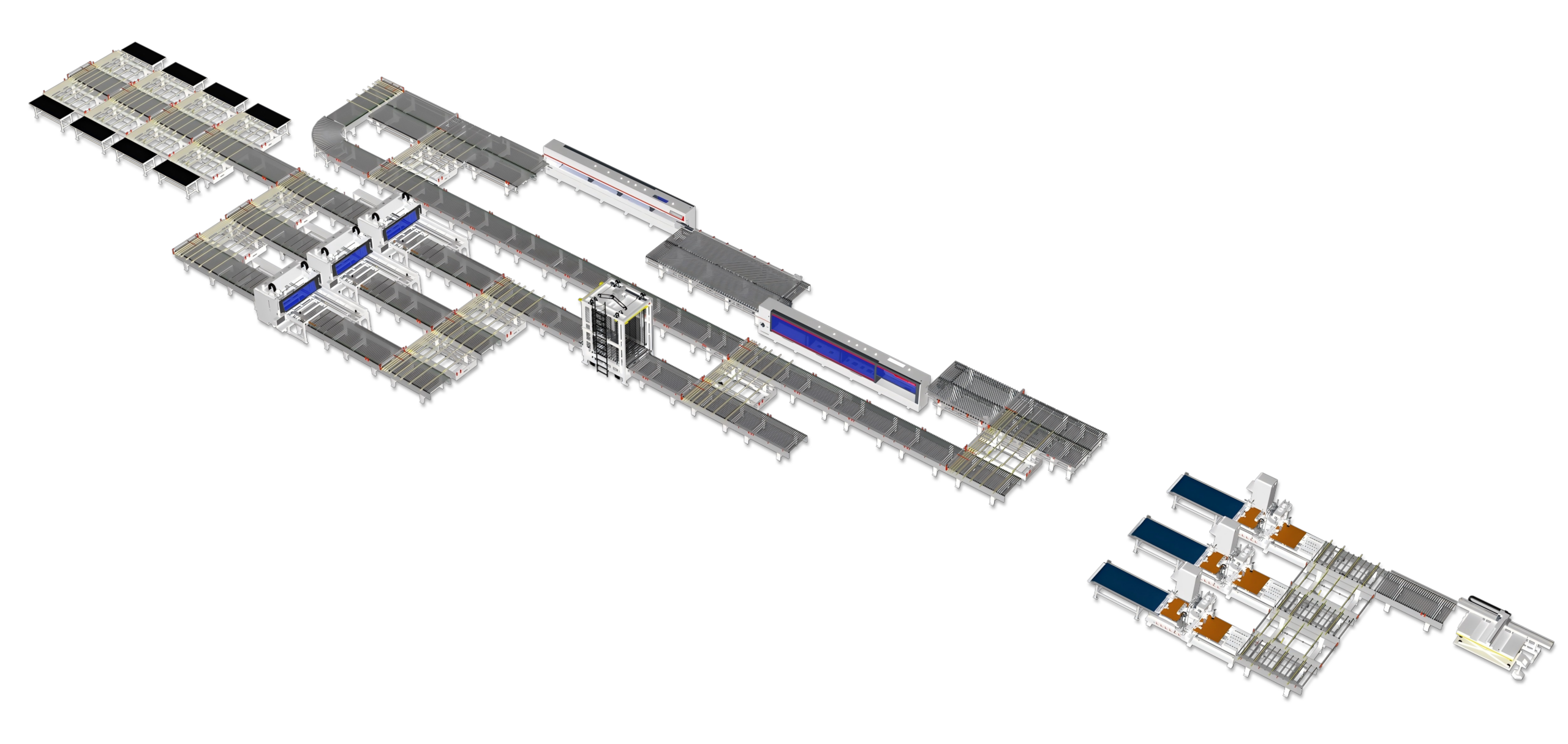
Understanding the Different Production Concepts
A CNC woodworking machine designed for nesting processes completes cabinet component cutting directly from full sheets using optimized digital layouts. The machine follows CAD/CAM data, allowing irregular shapes, grooves, holes, and complex contours to be processed within a single machining cycle.
Panel saw systems operate through a different production philosophy. Instead of machining finished parts immediately, they first divide large panels into rectangular workpieces with high cutting efficiency. Additional machining centers then perform drilling, routing, and profiling before final assembly. The workflow separates cutting from secondary processing to maximize throughput for standardized products.
Neither concept is universally superior. The appropriate choice depends on product diversity, factory organization, and production scheduling.
Production Flexibility for Custom Cabinet Orders
Modern customization continues to reshape cabinet manufacturing. Customers increasingly request personalized dimensions, decorative features, and varying internal structures, creating greater demand for flexible processing methods.
For manufacturers emphasizing customized production, woodworking CNC machinery offers significant operational advantages because programs can be generated directly from digital cabinet designs. Design modifications are transferred into machining instructions with minimal manual intervention, reducing setup changes between different orders.
Panel saw systems remain highly competitive for manufacturers producing standardized cabinet sizes in large batches. Repetitive cutting operations can be completed efficiently, especially when production plans involve long runs of identical panels.
Production flexibility therefore becomes a major evaluation factor rather than cutting speed alone.
Material Utilization and Cutting Efficiency
Raw material represents a significant proportion of cabinet manufacturing costs. Equipment selection should therefore consider how effectively sheet materials are converted into finished components.
Nesting technology utilizes optimization software to arrange cabinet parts across entire sheets before machining begins. A CNC woodworking machine can process irregular geometries while reducing unnecessary waste, particularly for mixed-order production where each sheet contains different component sizes.
Panel saw systems also achieve excellent material utilization when processing repeated rectangular components. Advanced cutting optimization software enables efficient panel division, although highly irregular component layouts may require additional processing steps afterward.
Factories should compare actual production data instead of assuming one technology consistently produces higher material savings.
Automation and Workflow Integration
Equipment performance increasingly depends on how well machines communicate with upstream software and downstream production equipment rather than operating independently.
Modern woodworking CNC machinery can integrate with production management software, automatic loading systems, labeling units, and intelligent material handling. Digital information accompanies every workpiece throughout manufacturing, improving production traceability while reducing manual data entry.
Panel saw production lines also support extensive automation through automatic feeding, stacking, sorting, and conveying systems. Large manufacturers often combine panel saws with drilling centers and automated storage systems to establish continuous production flow.
The best automation strategy should match factory scale, labor availability, and expected production growth.
Investment Considerations Beyond Equipment Purchase
The initial machine price represents only one part of the overall investment decision. Manufacturers should evaluate operating costs throughout the equipment lifecycle.
A CNC woodworking machine may reduce process transfers because cutting, routing, drilling, and slotting can often be completed on one platform. This integrated approach may simplify production management while reducing intermediate handling.
Panel saw systems may provide attractive economics for factories processing high volumes of standardized panels, especially when production balancing across multiple specialized machines has already been established.
When comparing investment options, we encourage customers to calculate labor requirements, maintenance planning, production scheduling, software compatibility, and future upgrade possibilities together rather than evaluating purchase cost alone.
Selecting the Right Solution for Factory Development
Every cabinet factory follows its own growth path. Equipment should support both current production requirements and future business objectives.
Manufacturers focusing on customized furniture, frequent design changes, and digital production often benefit from woodworking CNC machinery that supports flexible programming and integrated machining. The ability to process different cabinet components without extensive setup changes helps maintain production continuity across varying customer orders.
Factories dedicated to large-volume standardized cabinet production may continue to achieve excellent performance using panel saw systems combined with specialized downstream equipment. Their workflow can deliver stable productivity where product variation remains relatively limited.
Many expanding manufacturers eventually combine both technologies, assigning each machine to the applications where it performs most efficiently. Such hybrid production strategies allow businesses to balance flexibility with production capacity.
Why HUAHUA CNC Supports Practical Manufacturing Decisions
Equipment selection should always be based on manufacturing objectives rather than equipment trends. At HUAHUA CNC, we work with cabinet manufacturers to analyze production processes, product structures, automation requirements, and future expansion plans before recommending suitable solutions.
Our product portfolio covers advanced cabinet manufacturing equipment designed to integrate with modern digital production workflows. Whether customers require flexible CNC nesting technology, efficient panel processing solutions, or complete production line planning.
We focus on providing equipment configurations that match practical manufacturing needs. By emphasizing technical reliability, process integration, and long-term production efficiency, HUAHUA CNC aims to support cabinet manufacturers in building stable, scalable, and competitive woodworking operations.