
Reliable panel processing depends on more than advanced equipment. Daily operating practices, machine settings, and routine maintenance all influence cutting quality and production efficiency. We have worked with manufacturers that faced recurring production issues even when using modern equipment, only to discover that improper operation was the real cause.
At HUAHUA CNC, we believe that identifying common operational errors and correcting them systematically is essential for stable manufacturing.
Incorrect Panel Positioning Before Feeding
Improper positioning is one of the most common reasons for dimensional inaccuracies when operating a CNC panel saw. If the panel is not aligned correctly before feeding, the entire cutting process may be affected. Even small positioning errors can lead to inconsistent finished dimensions, additional material waste, and unnecessary rework.
We recommend checking panel alignment before every production cycle and ensuring the material remains stable during feeding. Operators should also verify that the panel is fully supported throughout transportation to prevent movement caused by uneven loading.
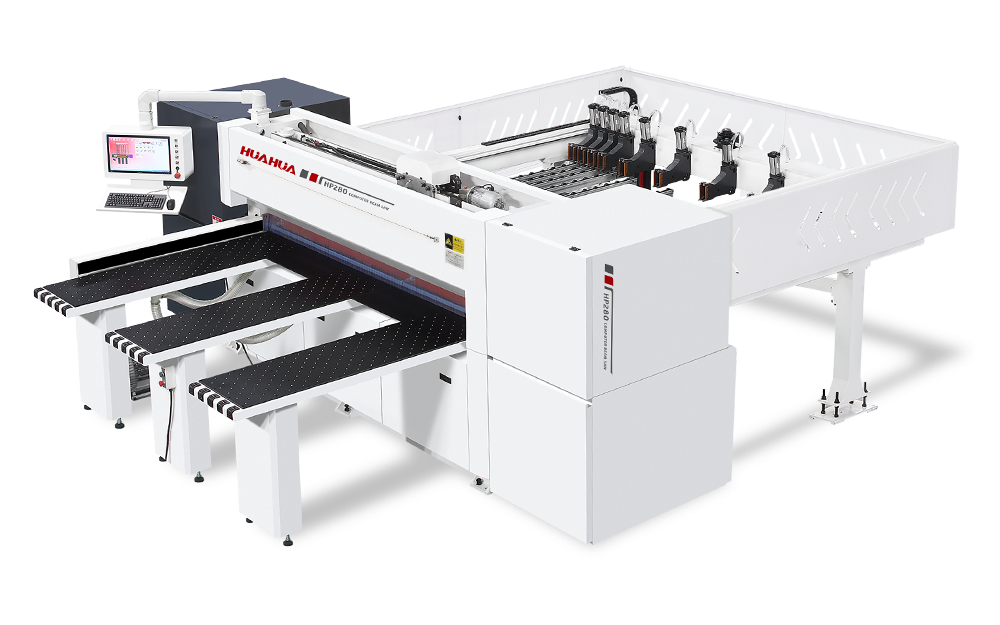
The HUAHUA CNC HP280 addresses this issue through a pneumatic two-finger clamping system that securely holds the workpiece during feeding. Combined with its roller conveyor and air-floating worktable, operators can move large panels more smoothly while maintaining stable positioning. These practical structural designs help improve handling efficiency without increasing operational complexity.
Improper Program and Cutting Parameter Settings
Incorrect program settings frequently reduce production efficiency on a CNC panel saw machine. Using unsuitable feed parameters or failing to verify cutting programs before production may result in repeated processing or inconsistent cutting performance across different panel sizes.
Instead of applying identical settings to every production order, operators should review processing requirements according to material specifications and cutting layouts. Program verification before machining is an effective way to minimize avoidable operating errors.
The HP280 is equipped with an Industrial PC Control System that supports cutting plan editing, operation guidance, cutting simulation, and troubleshooting assistance. These functions allow operators to review processing logic before production begins, helping reduce programming mistakes while improving workflow consistency.
The control system also supports factory automation integration, making production management more efficient for manufacturers with expanding operations.
Ignoring Saw Blade Configuration and Cutting Preparation
Many manufacturers pay attention to blade wear but overlook correct blade configuration on a CNC panel saw. Blade condition alone cannot guarantee stable cutting results if lifting positions or cutting preparation are incorrect before production starts.
Before each production shift, operators should inspect blade installation, fastening conditions, and cutting configuration. Regular preparation helps reduce unnecessary interruptions while maintaining stable cutting quality throughout continuous production.
The HP280 adopts independently controlled main saw and scoring saw lifting mechanisms. During operation, the machine automatically adjusts the saw stroke according to panel dimensions, reducing unnecessary movement and improving processing efficiency.
This design allows manufacturers to process different panel specifications with greater operational flexibility while maintaining consistent cutting performance.
Feeding Accuracy and Motion Control Errors
Production accuracy depends heavily on feeding stability when operating a CNC panel saw machine. Small positioning deviations may not be immediately visible, but they can gradually affect dimensional consistency during continuous batch production. If feeding components are not properly calibrated, accumulated errors may eventually influence finished product quality.
Regular inspection of feeding mechanisms and reference positions should become part of routine maintenance procedures. Operators should also verify servo system performance whenever production accuracy begins to change unexpectedly.
The HP280 utilizes a servo-driven saw carriage powered by a 2 kW servo motor, providing stable movement throughout the cutting process. Smooth motion control helps maintain repeatable positioning while supporting continuous production. Stable servo performance also reduces unnecessary mechanical impact, contributing to reliable long-term operation under industrial manufacturing conditions.
Neglecting Daily Maintenance and Machine Stability
Insufficient maintenance remains a common operational issue for every CNC panel saw. Dust accumulation, neglected inspections, and delayed maintenance can gradually reduce machine performance even when cutting parameters remain correct. Preventive maintenance is often more effective than repairing unexpected production failures.
Daily maintenance should include cleaning the worktable, checking pneumatic components, inspecting guide systems, and confirming that moving parts operate smoothly. Operators should establish standardized inspection procedures rather than responding only after production problems appear.
The HP280 features a rigid machine structure designed for long-term industrial applications. Its integrated steel frame provides stable support during continuous operation, while the air-floating worktable and roller conveyor simplify panel handling and routine cleaning. Together, these structural features help manufacturers maintain stable production environments through practical maintenance procedures.
Supporting Reliable Manufacturing with HUAHUA CNC
Reducing operational errors requires both standardized operating procedures and dependable equipment. At HUAHUA CNC, we focus on developing practical woodworking machinery that helps manufacturers improve production stability through reliable engineering rather than unnecessary complexity.
For you, the HP280 High-Speed Panel Saw combines stable mechanical construction, intelligent control technology, efficient material handling, servo-driven motion, and practical automation features to support consistent panel processing. By combining proper operator training with equipment designed for industrial production, manufacturers can reduce common operational errors, improve cutting consistency, and build a more reliable manufacturing workflow.