
Tool breakage on a CNC drilling machine represents one of the most disruptive failure modes in furniture panel production. A single incident can halt an entire processing line, render a batch of cabinet components unusable, and compress delivery schedules in ways that are difficult to recover from within a single shift. The associated costs — replacement tooling, unplanned downtime, and rework labor — accumulate rapidly and erode production efficiency in ways that are rarely captured by per-incident accounting alone.
The majority of tool failures on a CNC drilling machine for wood, however, are attributable to identifiable and addressable causes. This article examines the primary mechanical and operational factors that drive tool breakage in furniture production, outlines the tooling selection criteria appropriate for a CNC drill machine handling wood composites and solid timber, and details the programming practices and maintenance protocols that sustain reliable performance across high-volume production cycles.
What are the Primary Causes of Tool Failure in Furniture Production?
Before adjusting any parameters or changing any bits, it pays to understand why tools break in the first place. On a CNC drilling machine for wood, failures almost always trace back to one of three root causes: mechanical stress from incorrect cutting parameters, chip management problems, or spindle and clamping deficiencies.
Excessive Feed Rates and Incorrect Spindle Speeds
Feed rate and spindle speed are the two most directly controllable inputs on any CNC for woodworking. When feed is too high relative to speed, each cutting edge takes a larger chip than it was designed for, and brittle solid carbide bits fail under the resulting shock load — often not on the first panel, but on the third or fourth, once micro-stress accumulates. Spindle speed compounds this: too slow raises cutting force, while too fast generates heat that softens panel binders and glazes the edge. On a CNC drilling machine, the correct values shift with material, bit diameter, and hole type.
Poor Chip Evacuation in Dense Wood and MDF
MDF is among the most demanding materials a CNC drilling machine for wood encounters. Its fine, resin-laden fiber packs into the flutes; once chips pack, friction and heat spike and the tool breaks deep in the hole, often damaging the workpiece. Dense hardwoods clog differently — their tougher, springier fibers resist evacuation in ways that catch out bits proven on particleboard. Adequate dust extraction and correct flute geometry are the primary defenses, and a CNC for woodworking with well-positioned vacuum ports limits the chip re-cutting behind most friction-related breakage.
Spindle Runout and Improper Collet Clamping
Spindle runout — even in hundredths of a millimeter — wobbles the cutting path and loads each edge unevenly, so edges wear and break faster. No feed adjustment fixes this. Collet clamping is the same problem from the other side: a worn, dust-contaminated, or under-torqued collet allows micro-movement at the shank that is amplified into runout at the tip. On a CNC drilling machine, collets are precision consumables — inspect them regularly and replace them before they cost tools.
How to Optimize Tool Selection for a CNC Drill Machine?
Choosing the right bit for a given operation on a CNC drilling machine for wood is not purely a matter of cost or preference. Geometry, substrate type, and application all interact to determine whether a tool performs reliably or breaks early.
Choosing the Right Bit Geometry for Woodworking
Brad point bits have a centered point that registers precisely before the outer spurs begin to cut, making them the preferred choice for dowel holes, confirmat holes, and any application where placement accuracy is critical. The spurs shear the perimeter fibers cleanly ahead of the main body, minimizing tearout on melamine-faced panels — a defect just as costly as a broken tool when it forces rework. On a CNC drilling machine running cabinet carcass production, brad point bits are the workhorse.
V-point bits, by contrast, are optimized for clean through-holes. The acute tip angle lowers the force needed to break through a panel’s back face, reducing both tearout and the sudden load change that can snap a bit at breakthrough. On a CNC for woodworking handling cabinet backs, drawer bottoms, or hardware clearance holes, V-point bits produce clean exits without sacrificial backer boards.
Prioritizing Solid Carbide Tooling Over High-Speed Steel
On a production CNC drilling machine for wood, solid carbide is the appropriate standard over high-speed steel. Carbide holds its geometry through far higher cycle counts; resists heat at high spindle speeds and keeps hole tolerances tight across a full shift rather than drifting as the tool wears. The upfront cost rarely survives a production cost analysis: HSS bits replaced every few hundred holes cost more in aggregate — and in downtime — than carbide bits that run for thousands of holes before needing replacement.
What are the Techniques in Precision Programming and Operation for CNC Drilling Machine?
Even the best tooling breaks if the CNC machine for drilling is programmed carelessly. The relationship between material type and cutting parameters is not intuitive — what works in 18mm melamine particleboard may break tools immediately in 25mm moisture-resistant MDF or solid hardwood.
Adjusting Parameters for Different Wood Composites
Furniture production rarely involves a single material. A typical cabinet shop runs particleboard, MDF, plywood, and solid wood through the same CNC drill machine, sometimes on the same day. The key principle is that denser or more abrasive materials require either slower feed rates, higher spindle speeds, or both.
- For plywood, a reliable starting point for solid carbide brad point bits is 2,800–3,500 RPM with a feed rate between 2,000 and 3,000 mm/min, adjusting downward if chipping occurs at ply boundaries.
- For hardwoods such as oak and beech, feed rates should be kept conservative at 1,200–2,000 mm/min, with spindle load monitored throughout the run as an early indicator of impending tool stress.
Implementing Peck Drilling Cycles for Deep Hole Applications
For any hole deeper than approximately three times the bit diameter, peck drilling is the most reliable strategy on a CNC drilling machine. By retracting the tool at set intervals to clear chips before re-engaging, peck cycles prevent the flute packing that causes friction-driven breakage in deep MDF holes. The peck depth should be set at roughly one to one-and-a-half times the bit diameter for MDF and can be increased slightly for plywood to balance throughput against reliability.
HUAHUA SKH-612NS: Precision CNC Drilling Machine for Wood
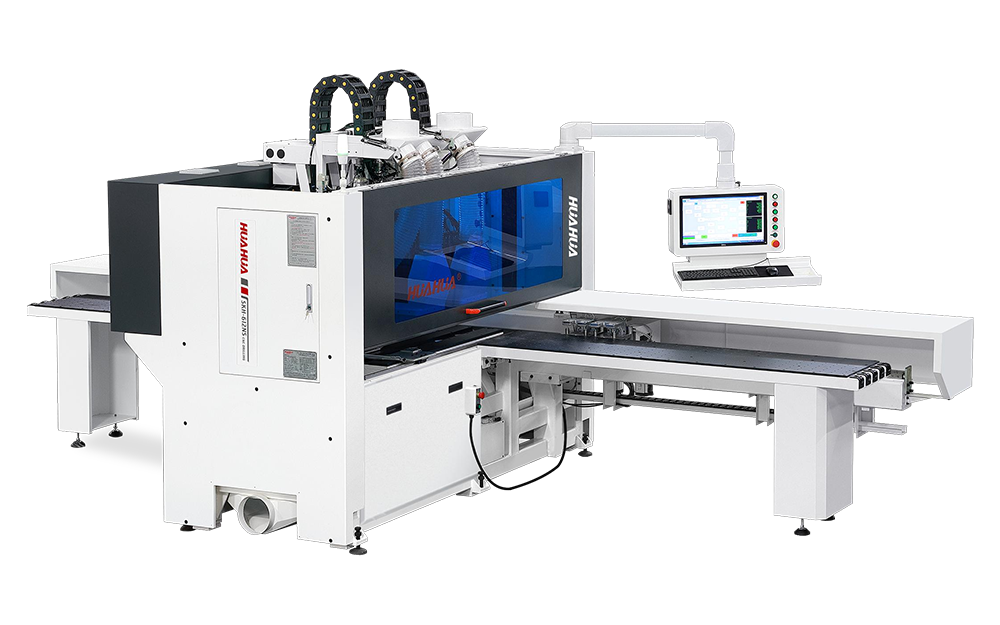
Understanding the principles above makes it easier to evaluate which CNC drilling machine is equipped to support them in practice. The HUAHUA SKH-612NS is a six-sided CNC drilling machine designed specifically for furniture panel production, with a specification that addresses the key failure drivers discussed throughout this article.
Dual Drilling Heads for Higher Output
The SKH-612NS runs dual precision drilling heads — each equipped with 12 vertical and 8 horizontal drilling bits on top, plus a 9-bit vertical array on the bottom — driven by rack and pinion transmission on both axes. Rack and pinion delivery maintains positional accuracy across the full working stroke in a way that suits high-cycle furniture production, and the dual-head configuration increases capacity by approximately 20% over single-head machines when hole spacing exceeds 85mm, a common condition on bathroom cabinet and kitchen cabinet panels.
Syntec Control System for Stable, Long-Run Performance
Spindle control is handled by a Taiwan Syntec absolute-value control system, which eliminates homing requirements at startup and maintains stable performance across long service intervals. The same Syntec platform drives servo motor clamping with positioning speeds up to 130 m/min — fast enough to keep up with high-volume production schedules without sacrificing placement accuracy.
Integrated Dust Extraction to Protect Tool Life
On the dust management side, the SKH-612NS uses separated vacuuming ports for different processes, combining blowing and suction to clear chips effectively. This directly supports the chip evacuation principles discussed earlier: clean flutes produce less heat, less heat means longer tool life, and longer tool life means fewer breakage events per shift.
Wide Workpiece Compatibility Across Standard Furniture Dimensions
The machine accepts workpieces from 50mm to 1,200mm wide and up to 4,200mm long, with thickness from 10mm to 48mm — a range that covers the full spectrum of standard furniture panel dimensions. QR code scanning loads processing files automatically in MPR, DXF, BAN, and XML formats, reducing manual programming time and the parameter entry errors that can result in mismatched feed/speed settings.
Flexible Configuration for Automated Production Lines
Optional configurations include side slot and surface slotting, ATC tool changer integration, and a side discharge lifting unload table for automated line integration. The machine ships with CE certification and carries ISO quality assurance. For furniture manufacturers looking to reduce tool breakage on their CNC drilling operations, the SKH-612NS provides the mechanical precision, chip management infrastructure, and control system stability that make the maintenance and operating practices described above achievable in a production environment.

Conclusion
Tool breakage on a CNC drilling machine for wood is a solvable problem. The underlying causes — excessive feed rates, poor chip evacuation, spindle runout, worn collets, and unsecured workpieces — each respond to specific, actionable countermeasures. Apply the right bit geometry to each application, calibrate feed and speed settings to the actual material being cut, program peck cycles for deep holes, and maintain the clamping and spindle systems with the same seriousness as the tooling itself.
The most effective operations are those where machine capability, tooling choice, and operating discipline reinforce each other. A CNC drilling machine built with the right mechanical foundations — precise rack and pinion transmission, stable spindle control, and effective chip extraction — makes it far easier to sustain those practices consistently. This is exactly the design philosophy behind the HUAHUA SKH-612NS, and it is what turns a manageable breakage rate into a negligible one.
Ready to cut tool breakage on your furniture production line? Explore the SKH-612NS CNC drilling machine and contact HUAHUA to see how the right machine foundation supports lower breakage rates and higher uptime.