
Industry 4.0 is moving furniture production from isolated machines toward connected equipment, software, data, and automation. NIST describes smart manufacturing as integrated systems that respond to changing factory and customer demands.
For panel furniture manufacturers, a smart factory solution can coordinate material handling, cutting, edge banding, drilling, and production data. The question is which partner can build a smart furniture factory around actual production needs.
This guide examines automated furniture manufacturing and the one-stop auto workshop model.
What Production Challenges Drive Smart Factory Upgrades?
Factories upgrade when existing workflows can no longer manage product variety, costs, or delivery requirements. A suitable smart factory solution addresses these constraints across the plant.
Increasing Demand for Customized and Small-Batch Production
Custom orders change dimensions, finishes, drilling patterns, and quantities. Smart line production uses digital job data to handle small batches with fewer adjustments.
Connected furniture factories can also combine repetitive output with batch-size-one production.
Low Efficiency from Disconnected Production Processes
Separate cutting, edge banding, drilling, sorting, and material movement create waiting, repeated data entry, and extra handling. These gaps hide bottlenecks and reduce total line efficiency.
Rising Labor Costs and Production Management Difficulties
Manual loading, transfer, tracking, and scheduling require labor and coordination. Automated furniture manufacturing reduces repetitive handling and moves employees toward supervision, quality control, and exception management.
Higher Requirements for Accuracy, Delivery, and Capacity Utilization
Dimensional consistency and reliable routing affect downstream work. Shorter lead times also require balanced equipment and material flow. Connected production improves capacity use and keeps orders moving toward delivery.
How Does a Customized Smart Factory Integrate Production?
NIST defines Industry 4.0 through the integration of cyber and physical production systems. In a smart furniture factory, equipment, software, data, and material flow operate as one smart factory solution.
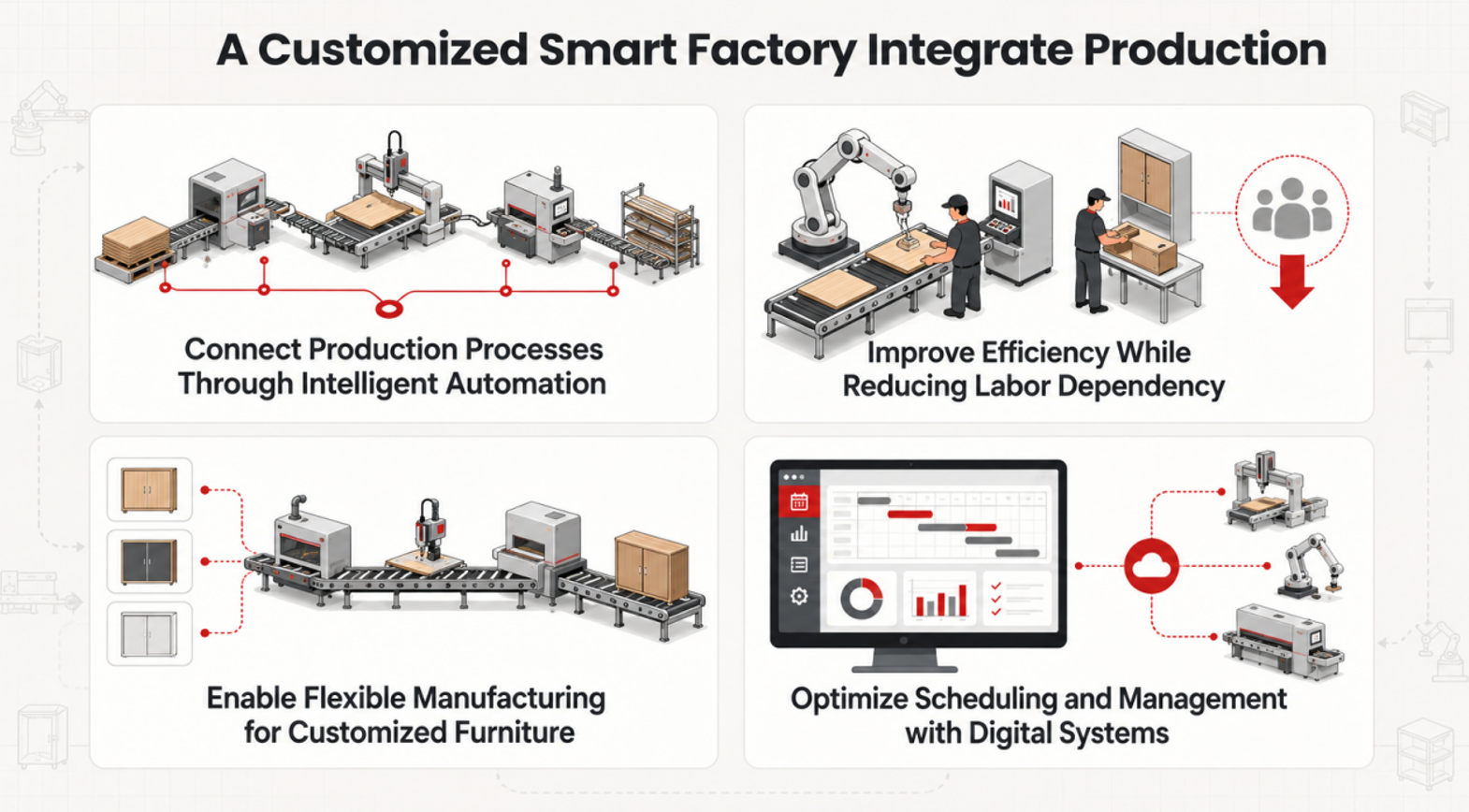
Connect Production Processes Through Intelligent Automation
Feeders, conveyors, buffers, and return systems link cutting, edge banding, and drilling. Production data follows each panel, reducing repeated entry and transfers. This supports smart line production.
Improve Efficiency While Reducing Labor Dependency
Automated loading, conveying, buffering, and routing reduce repetitive handling. Operators monitor production and exceptions instead of moving every panel, reducing labor dependency in automated furniture manufacturing.
Enable Flexible Manufacturing for Customized Furniture
Design and order data guide different panel sizes and configurations. A flexible smart factory solution handles mixed orders and smaller batches within a one-stop auto workshop for customized production.
Optimize Scheduling and Management with Digital Systems
Digital systems bring job status, machine information, and production progress together. Managers can monitor machining, identify congestion, and adjust schedules using current data. Digital systems combine job status, machine information, and production progress. NIST notes that near-real-time data can support alternative plans, scheduling, and operational optimization. Managers can then adjust priorities using current information.
How to Evaluate a Smart Factory Solution Provider?
The smart factory solution provider determines how effectively machines, data, and operations work together. Evaluation covers five practical areas.
Turnkey Planning Capabilities
A capable partner develops the layout around the workshop, products, current equipment, target capacity, and material flow. This determines whether a one-stop auto workshop operates as an integrated system.
Integrated Software Systems
Software should connect orders, processing instructions, production monitoring, and equipment status. Integration reduces data gaps between planning and machining while showing work in progress.
Complete Automation Solutions
A smart factory solution should coordinate processing equipment with loading, conveying, buffering, return, and storage. Its value comes from workflow continuity rather than one automated station.
Scalable Production Line Design
The layout should support present output and practical changes as volume or product mix develops. A scalable smart furniture factory can expand as capacity requirements change.
Professional Implementation and After-Sales Support
Installation, commissioning, training, spare parts, and technical service affect production readiness. Clear responsibility across these stages reduces integration risk.
How Does the HUAHUA A8 Meet These Evaluation Criteria?
The HUAHUA A8 combines factory planning, self-developed software, connected equipment, and support services in a smart factory solution for panel furniture production.

Customized Turnkey Production Line Planning
The A8 can support an existing-line upgrade or a complete factory plan. Its layout reflects product type, production mode, capacity, current equipment, and workshop dimensions.
The A8 includes HUAHUA’s self-developed HHM system for straightforward operation and a Manufacturing Execution System (MES) for real-time machining monitoring. Together, they support data-based control in a smart furniture factory.
Connected Automation and Intelligent Material Flow
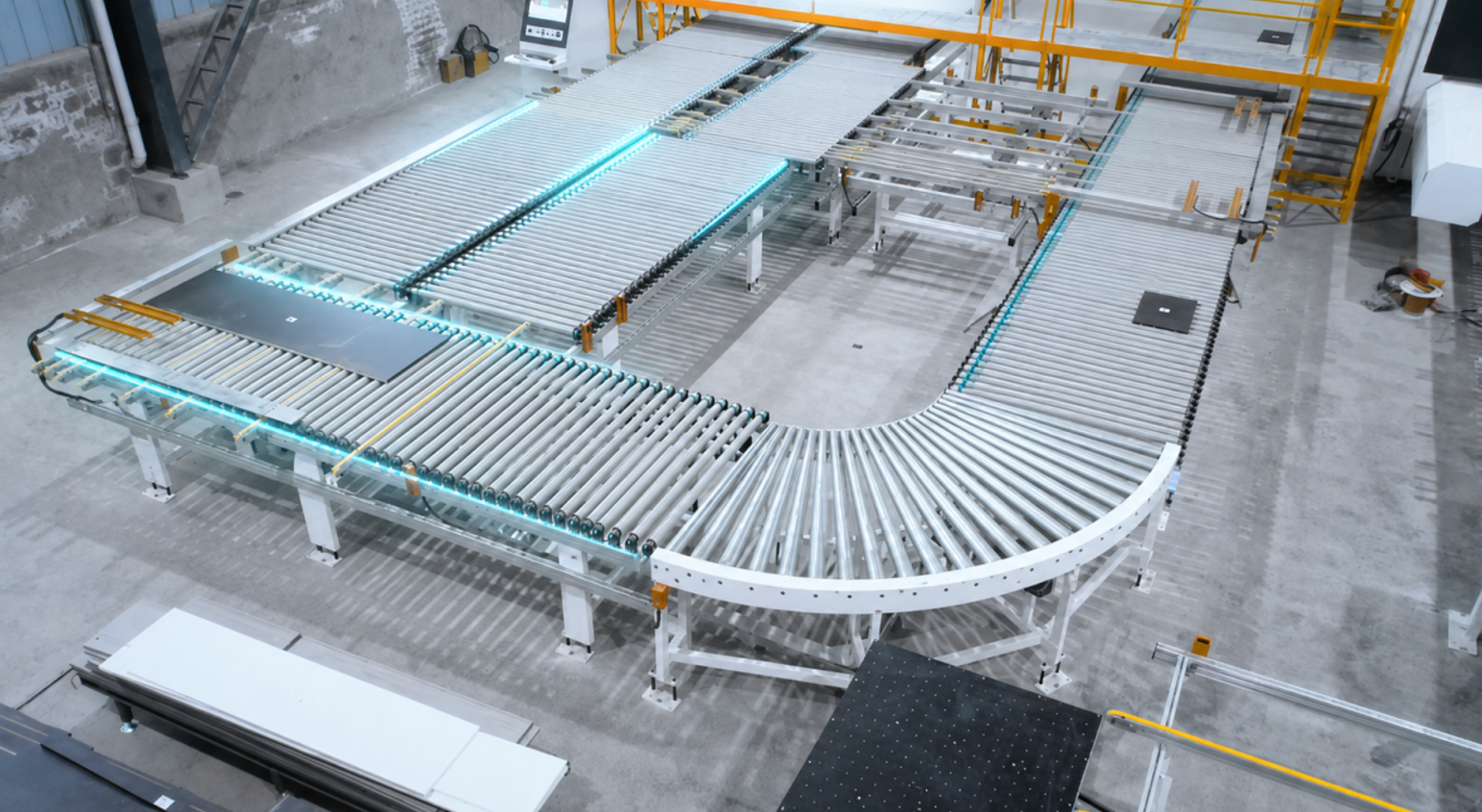
The A8 connects cutting, edge banding, six-sided drilling, and milling in a smart line production layout. Gantry feeding, panel storage, buffering, and automatic return support material flow between processes. The official configuration lists a speed of 26 m/min and capacity of 350–380 pieces per day.
Flexible and Scalable Line Configurations
Planning around workshop size, equipment, products, and capacity allows the smart factory solution to support focused upgrades or a broader one-stop auto workshop without imposing one layout on every plant.
Project Implementation and Technical Support
HUAHUA provides planning, field installation, commissioning, training, spare parts, technical support, and after-sales service. Its field team handles assembly and connections, then checks inputs, outputs, safety circuits, interlocks, and motor rotation.
Conclusion
The best smart factory solution connects equipment, material flow, production data, and management around actual products and capacity goals. It supports customization, steadier workflow, lower labor dependency, and clearer control.
Founded in 2003, HUAHUA has extensive experience in CNC woodworking machinery, panel furniture lines, and customized factory planning. The A8 brings these capabilities into one system for automated furniture manufacturing.
Consult HUAHUA for a tailored solution based on your workshop, equipment, output, and products.
References
- National Institute of Standards and Technology. Smart Manufacturing Operations Planning and Control Program.
- https://www.nist.gov/programs-projects/smart-manufacturing-operations-planning-and-control-program/
- National Institute of Standards and Technology. Digital Twins in Manufacturing.
https://www.nist.gov/el/systems-integration-division-73400/prep-fellowship-digital-twins-manufacturing