
Panel furniture factories are handling shorter runs, more variants, and tighter assembly requirements. A CNC panel saw affects dimensions, edge quality, drilling alignment, edge-banding fit, and hardware installation.
A dimensional error can continue through downstream operations, creating gaps, rework, or scrap. The best saw for cutting paneling therefore depends on tolerances, panel sizes, materials, volume, and workflow.
This guide explains how to match a high-precision CNC panel saw to those needs.

What Causes Panel-Cutting Errors?
Panel-cutting errors can occur even when the operator follows the correct setup and cutting program. Insufficient machine rigidity, unstable positioning, and poor blade condition can all prevent the machine from maintaining the required cutting accuracy.
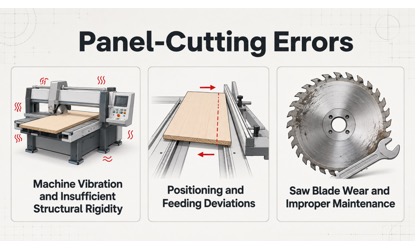
Machine Vibration and Insufficient Structural Rigidity
Cutting forces can cause vibration or slight deflection in a lightweight or poorly supported frame. Movement at the carriage, guideways, or worktable may then reduce dimensional consistency and edge quality.
Positioning and Feeding Deviations
Panels can shift when pushers, clamps, aligners, or support tables do not hold them consistently. Backlash, worn guides, poor calibration, and debris at reference surfaces also change dimensions.
Saw Blade Wear and Improper Maintenance
Dull or contaminated teeth increase cutting force and can cause chipping, burning, or deflection. Incorrect blade selection and scoring alignment further reduce quality. Inspection, cleaning, sharpening, and replacement intervals should reflect the material and cutting volume.
Which Specifications Matter When Purchasing a CNC Panel Cutting Machine?
Panel dimensions, stack height, surface type, throughput, and required finish determine which specifications provide useful accuracy. The key specifications should match the panels being processed, required cutting quality, and production output.
Machine Frame Structure and Guide Rail Accuracy
Review frame rigidity, stress-relief treatment, machine weight, and guide-rail stability. The best saw for cutting paneling should maintain smooth and stable movement during continuous cutting.
Servo Motor, Positioning Accuracy, and Repeatability
Servo-driven feeding and carriage movement help control panel positioning and cutting consistency. For a high-precision CNC panel saw, stable and repeatable movement matters as much as cutting speed.
Automatic Clamping System and Feeding Accuracy
Review how the clamps, feeding components, panel supports, and side alignment work together. Panels should remain stable during feeding and cutting without surface damage.
Saw Blade Configuration and Scoring Saw System
Consider the main and scoring saw dimensions, motor power, spindle speed, and supported cutting thickness. A correctly configured scoring saw helps reduce lower-face breakout on laminated and veneered panels.
CNC Control System and Cutting Optimization Software
Look for clear cutting-plan entry, execution guidance, troubleshooting support, and compatibility with barcode or factory software. Optimization software can improve layout planning and remnant use when comparing CNC panel cutting machines.
How Does the HUAHUA HP280 Support Precision and Stable Production?
The HUAHUA HP280 is an industrial CNC panel saw designed for panel processing. It combines a stress-relieved welded frame, servo-driven saw carriage and feeding systems, pneumatic clamping, and independently lifted main and scoring saws.
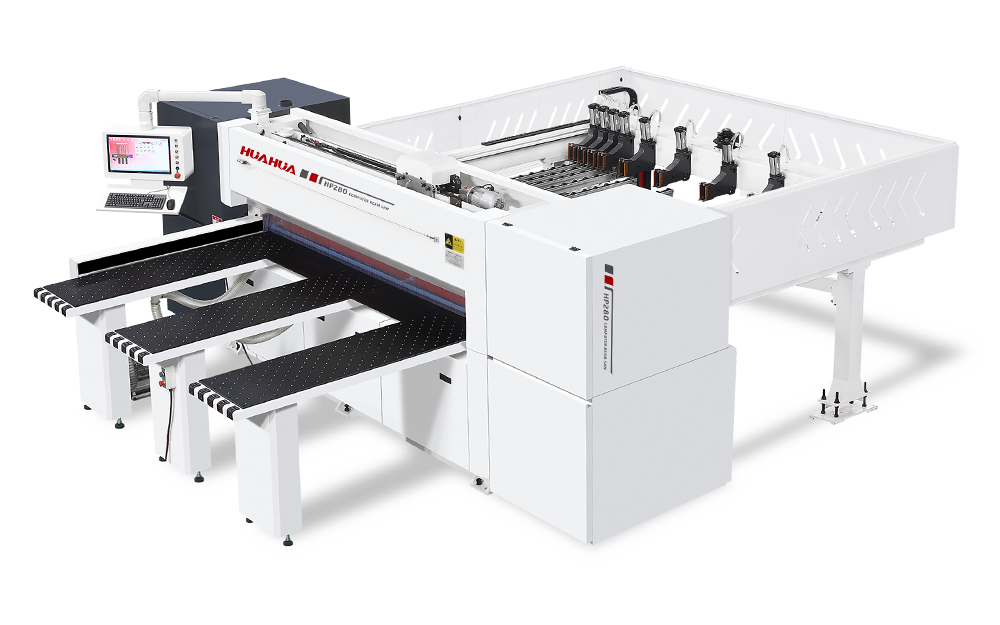
Stable Welded-Frame Construction
The HP280 has a net weight of 5,300 kg. Its maximum cutting length is 2,800 mm, while its maximum cutting thickness is 120 mm. The welded frame is left to stabilize, heat-treated to relieve residual stress, and then precision-machined. This process is intended to improve machine-body stability.
Precision Positioning and Intelligent Control System
The saw carriage is driven by a 2 kW AC servo motor. The industrial PC allows operators to edit, simulate, and execute cutting plans and provides operating prompts and troubleshooting guidance.
It is also compatible with barcode management software and factory automation software.
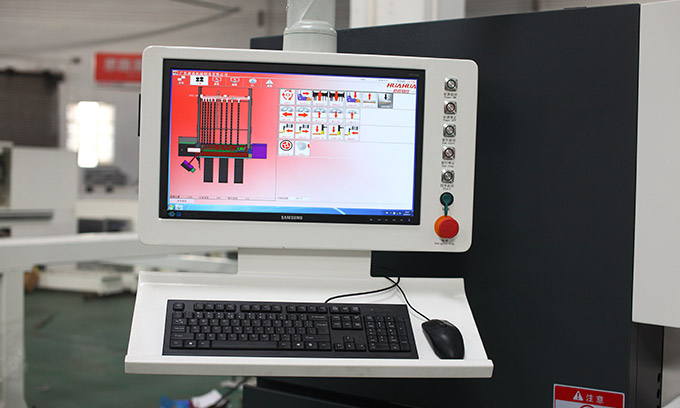
Optimized Feeding and Clamping System
Two-finger pneumatic clamps secure the panel during feeding, while roller conveyors and three air-flotation tables make heavy panels easier to move and help reduce surface scratching.
The automatic feeding speed reaches 85 m/min. An optional pressure-adjustable side aligner helps prevent the panel from moving or shaking during sawing, supporting more consistent cutting dimensions.
Efficient Cutting Performance
The 18.5 kW main saw operates at 4,000 rpm, while the 2.2 kW scoring saw runs at 5,200 rpm. Saw-carriage speeds reach up to 100 m/min forward and 120 m/min backward.
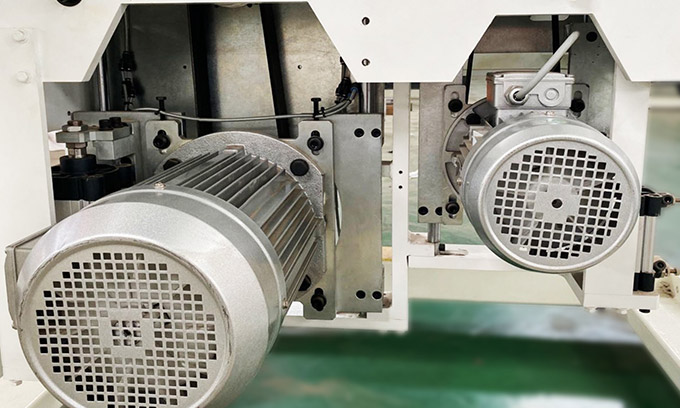
The main saw and scoring saw lift independently, while optional cutting-optimization software automatically calculates cuts, lays out cutting plans, and manages remnants to support productivity and panel utilization.
What Is the Long-Term Value of a High-Precision CNC Panel Saw?
The long-term value of a high-precision CNC panel saw comes from fewer rejected parts, smoother downstream processing, and lower correction costs.
These benefits become more significant as production volume and product variety increase.
Reduced Rework and Material Waste
Accurate cutting produces more usable parts from each sheet and reduces panels rejected because of dimensional errors or poor edge quality. Less recutting also means fewer wasted materials and less downstream correction.
Improved Production Efficiency
Panels cut to the correct dimensions can move directly to edge banding, drilling, and assembly without repeated measurement or correction. A suitable CNC panel cutting machine supports a smoother production flow by reducing interruptions between processing stages.
Lower Operating Costs Over Time
High cutting accuracy reduces scrap, rework labor, and the machine time consumed by repeated cuts. These savings accumulate as production volume increases.
Greater Competitiveness in Customized Manufacturing
Customized production involves varied panel dimensions, shorter batches, and frequent job changes. A high-precision CNC panel saw maintains dimensional consistency across these changing requirements, helping manufacturers complete complex orders with reliable quality and shorter turnaround times.
Conclusion
Selecting a CNC panel saw requires a balanced review of rigidity, positioning, feeding, clamping, blade configuration, controls, and software. The right configuration reduces errors while supporting predictable output and material utilization.
Founded in 2003, HUAHUA specializes in CNC woodworking machinery and panel-furniture solutions. The HP280 offers a 2,800 mm cutting length, 120 mm cutting thickness, servo-driven carriage, pneumatic clamping, and independent main and scoring saws.
For more support in selecting high-precision equipment, contact HUAHUA to discuss your panel furniture production needs.