
A sliding table saw is often the starting point for a panel furniture factory. It is relatively easy to operate, flexible enough for small batches and suitable for workshops where production depends heavily on experienced operators. However, as order volumes increase and product designs become more varied, manual cutting can gradually become a bottleneck.
Operators must move and position heavy sheets, interpret cutting lists, adjust dimensions and label finished panels manually. These activities take time and create opportunities for cutting errors, material waste and production delays. Adding more sliding saws may increase capacity temporarily, but it also increases labor requirements and makes production management more complicated.
Upgrading to automated furniture manufacturing therefore means more than replacing a manual saw. A successful project should connect order data, cutting optimization, automatic feeding, panel identification and downstream processing into a coordinated workflow.

When Should a Factory Upgrade Its Sliding Saws?
Before investing in new machinery, manufacturers should confirm whether manual cutting is genuinely limiting factory performance. Several operational problems commonly indicate that an upgrade is necessary.
Cutting Capacity Cannot Keep Up with Orders
The output of a sliding saw depends heavily on the operator’s working speed. When order volume rises, factories may need additional shifts or operators to increase production. This approach becomes difficult to sustain when labor costs increase or skilled saw operators are hard to recruit.
A CNC panel saw can execute programmed cutting plans and complete repetitive cuts without requiring the operator to measure and reposition every panel manually. This makes production capacity more predictable.
Cutting Quality Varies Between Operators
Manual measurement, positioning and feeding can cause dimensional variations. Even relatively small cutting errors may create problems during edge banding, drilling or assembly.
When cutting is controlled by CNC programs, panel dimensions are no longer determined primarily by individual operator experience. Servo-controlled feeding, stable clamping and programmed cutting sequences help maintain more consistent results across different shifts.
Material Waste Is Difficult to Control
In a manual workshop, operators may prepare cutting layouts based on experience or individual job sheets. This can make it difficult to optimize material use across multiple orders or manage reusable offcuts systematically.
Cutting optimization software can combine panel requirements, generate more efficient layouts and record usable remnants. The factory can therefore improve material planning before a sheet reaches the saw.
Work-in-Process Becomes Difficult to Track
A factory may cut hundreds of panels for different cabinets, wardrobes or customer orders during the same shift. Without automatic labels or digital identification, panels can be mixed, misplaced or delivered to the wrong downstream process.
Barcode-based identification allows each panel to carry information such as its order number, dimensions, edge-banding requirements, drilling program and assembly destination.
Define the Automation Target Before Selecting Equipment
Automation should solve clearly defined production problems. The factory should first establish its current performance and determine what the upgraded system must achieve.
The following information should be collected before equipment selection:
| Area | Information to Measure |
| Production Demand | Panels processed per shift, peak demand and expected growth |
| Product Mix | Standard products, customized orders and average batch size |
| Panel Specifications | Maximum sheet dimensions, thicknesses and materials |
| Current Performance | Cutting time, changeover time, scrap rate and rework rate |
| Labour | Operators required for loading, cutting, labelling and sorting |
| Downstream Capacity | Edge banding, drilling and assembly throughput |
| Infrastructure | Available floor space, electrical supply, compressed air and dust extraction |
| Digital Systems | Design software, ERP, MES, barcode system and production-planning software |
These figures help determine whether the factory needs a standalone CNC saw, an automated cutting cell or a fully connected production line.
The new cutting system should not be sized only for the highest possible speed. If edge banding or drilling cannot receive panels at the same rate, faster cutting will simply create more work-in-process. Equipment capacity must be balanced across the entire production flow.
A Step-by-Step Roadmap for Automating the Factory
A phased upgrade usually gives an existing factory more control over investment, commissioning and employee training. Each phase should create a foundation for the next one.
Phase 1: Standardize Production Data
The factory should first establish a reliable digital workflow from furniture design to panel cutting. Product dimensions, material specifications and machining requirements should follow a consistent data structure.
Cutting lists generated by design or production software should be transferred to optimization software rather than entered repeatedly by operators. This reduces transcription errors and allows cutting plans to be prepared before production begins.
The factory should also introduce a consistent panel identification system. Every cut panel should receive a unique barcode or label that remains with it through edge banding, drilling, sorting and assembly.
Phase 2: Replace the Sliding Saw Bottleneck with a CNC Panel Saw
The next step is replacing the main manual cutting bottleneck with a CNC beam saw or panel saw. Unlike a sliding saw, a CNC panel saw automatically positions the material according to the cutting program.
◉ Important selection criteria include:
◉ Maximum cutting length and thickness
◉ Feeding and saw-carriage speed
◉ Cutting accuracy and repeatability
◉ Stack-cutting requirements
◉ Clamping and alignment design
◉ Compatibility with optimisation and barcode software
◉ Loading and unloading options
◉ Dust extraction and safety requirements
◉ Local installation, training and spare-parts support
The existing sliding saw does not necessarily have to be removed immediately. It may remain useful for prototypes, occasional rework, unusual materials or low-volume special components while the CNC saw handles planned production.
Phase 3: Automate Loading, Labelling and Panel Transfer
Installing a CNC saw removes much of the manual measuring and positioning, but operators may still spend considerable time loading sheets, moving cut components and applying labels.
The cutting cell can therefore be expanded with automatic or semi-automatic loading, conveyors, lifting equipment and an automatic labelling system. These additions reduce repeated panel handling and help maintain a continuous flow through the cutting area.
Labels should be generated directly from production data. After cutting, each panel can be identified immediately and directed to the correct edge-banding or drilling process.
Phase 4: Connect Edge Banding and Drilling
Cutting should eventually operate as part of a wider production system. Conveyors, return lines, rotating stations and buffer areas can move panels between different processes while reducing manual handling.
Barcode scanners can retrieve the correct processing instructions at each station. An edge banding machine can identify the required panel edges, while a six-sided drilling machine can load the corresponding drilling and grooving program.
Buffer storage is particularly important. It prevents short interruptions at one machine from stopping the entire line and allows panels to be temporarily organised according to order or processing sequence.
Phase 5: Introduce Central Production Control
At a more advanced level, the factory can connect its design software, production planning, optimisation, machines and material-handling system through an MES or similar control platform.
Managers can then monitor order progress, machine status, output and processing exceptions in real time. Instead of relying on handwritten records or verbal updates, the factory obtains a traceable production history for each panel.
Central control also makes mixed-order manufacturing more manageable. Different panel sizes and designs can pass through the same line while the system distributes the appropriate data to each machine.
Recommended HUAHUA Solutions for Different Upgrade Stages
HUAHUA offers CNC panel saws as well as integrated production lines covering cutting, edge banding, drilling, sorting and packaging. The most appropriate solution depends on the factory’s current scale and automation target.
Entry-Level Upgrade: HUAHUA HP Series CNC Panel Saw
For a factory that currently depends on sliding table saws, an HP Series CNC panel saw from HUAHUA is a practical first step. We offer different cutting lengths, including:
→ HP280: maximum cutting length of 2,800 mm
→ HP330: maximum cutting length of 3,300 mm
→ HP380: maximum cutting length of 3,800 mm
The HUAHUA HP280 is suitable where the factory mainly processes standard-sized panels within its cutting range. Its industrial PC can edit, simulate and execute cutting plans and is designed to work with barcode-management or factory-automation software. Optional cutting optimization software provides cutting-plan calculation, layout preparation and remnant management.
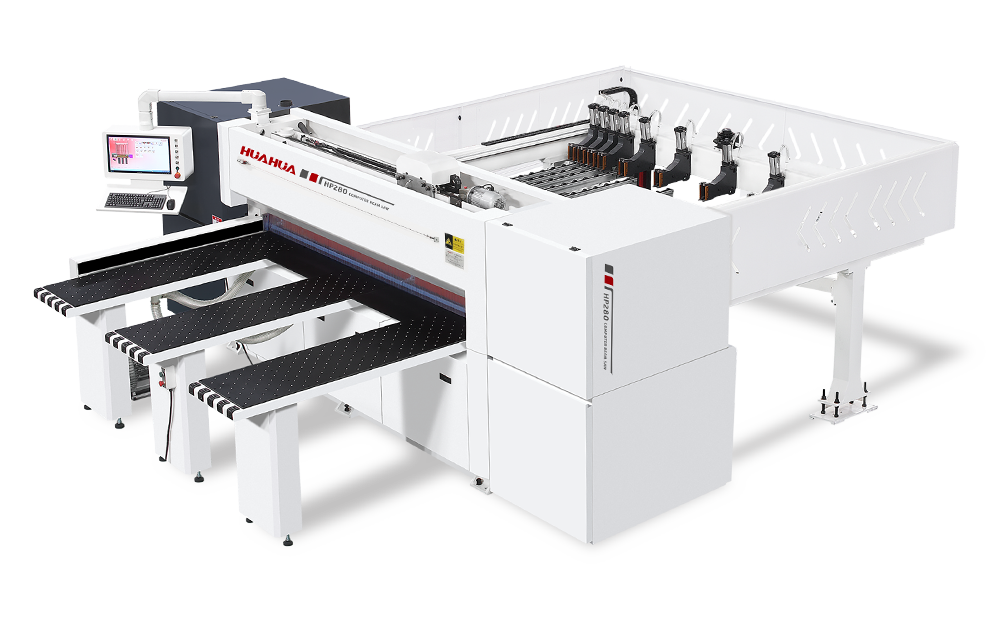
Pneumatic clamping holds the panels during feeding, while roller conveyors and an air-floating worktable make heavy sheets easier to handle and help protect their surfaces. Automatic adjustment according to panel thickness and cutting width also reduces repeated manual setup.
For factories that regularly process panels longer than 2,800 mm, the HP330 provides a more flexible 3,300 mm cutting length. The HP380 should be considered where even longer panels are part of normal production.
The model should be selected according to actual panel dimensions rather than buying unnecessary capacity. Space, electrical load, extraction requirements and future loading automation must also be included in the decision.
Advanced Upgrade: HUAHUA Smart Panel Furniture Production Line
Factories ready to move beyond an automated cutting cell can consider the HUAHUA Furniture Production Line A8. This Industry 4.0 solution is designed to replace a sliding-table-saw-based workflow with an integrated system covering automatic material loading and unloading, cutting, drilling, grooving, milling and edge banding.
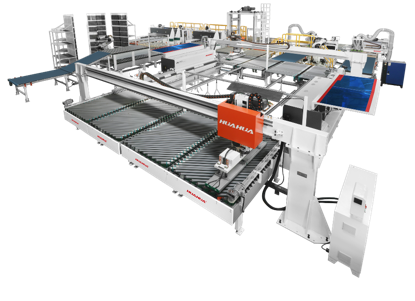
Rather than operating each machine as an isolated workstation, the A8 combines production planning, digital information and processing equipment within one coordinated workflow. It is particularly suitable for manufacturers of cabinets, wardrobes and other panel furniture that process a large number of customised components every day.
Automated Panel Feeding and Material Flow
The A8 uses a gantry feeder to transfer panels to the roller conveyor, reducing the manual handling of heavy sheets at the beginning of production. After machining, an automatic return line can collect and redirect panels for subsequent processing.
The production line also includes temporary panel storage and buffer areas. When a downstream process becomes congested, panels can be stored temporarily instead of stopping the entire line. This helps balance production between cutting, edge banding and drilling.
Connected Production Management
HUAHUA equips the A8 with its self-developed HHM system and MES. The HHM system supports daily line operation, while the MES provides real-time monitoring of the machining process.
By connecting furniture design and production software, the line can receive order data, support automatic order breakdown and generate optimised panel layouts. This reduces repeated manual data entry and allows different customised orders to be processed through the same production system
Production Capacity
According to HUAHUA’s published specifications, the A8 can operate at up to 26 metres per minute and process approximately 350–380 pieces per day. Actual output will depend on panel dimensions, product complexity, batch structure, operating hours and the balance between individual machines.
HUAHUA also states that the line can reduce labour costs by at least 60% and increase panel utilisation to as much as 95%. These figures should be treated as supplier-reported targets and verified against the factory’s existing performance during project planning..
How to Implement the Upgrade Without Disrupting Production?
Installation should be planned as an operational project rather than a simple machine delivery.
Complete Factory Acceptance Testing
Before shipment, representative panel materials and real cutting files should be used to test the proposed configuration. The test should cover dimensional accuracy, cutting quality, barcode generation, software transfer and production-cycle time.
Prepare the Factory Infrastructure
The factory must confirm the equipment footprint, foundation, power supply, compressed-air capacity, dust extraction, network connections and material routes. Space should also be reserved for raw-panel staging, offcut storage and finished-panel buffers.
Run the Old and New Processes in Parallel
During the initial commissioning period, the CNC system can handle selected product families while the sliding saw remains available as a backup. More orders can be transferred to the automated cell after cutting accuracy, software integration and operator competence have been confirmed.
Train More Than One Operator
Training should cover program loading, cutting-plan verification, blade changes, barcode handling, preventive maintenance and fault recovery. Maintenance technicians and production planners should understand the system as well as machine operators.
HUAHUA lists machine-solution planning, field installation, operation training, spare-parts supply and technical support among its service capabilities. Buyers should still confirm the exact service scope, response time, warranty terms and local support arrangements in the purchase contract.
Measure Performance After Commissioning
The factory should compare the new system with the original baseline using indicators such as:
◉ Panels or sheets processed per shift
◉ Labour hours per processed sheet
◉ Material yield
◉ Cutting and labelling error rate
◉ Rework volume
◉ Machine utilisation
◉ Downtime
◉ Work-in-process between cutting and downstream operations
◉ On-time order completion
These measurements show whether the new equipment is generating real operational improvements and identify the next process that should be automated.
Calculate the Full Investment, Not Only the Machine Price
The total project budget should include the CNC saw, loading and transfer equipment, software, labels and scanners, dust extraction, electrical work, installation, freight, training, spare parts and production downtime during commissioning.
A simple evaluation can use the following formula:
Annual net benefit = labour savings + material savings + avoided rework + additional contribution from higher output − additional operating and maintenance costs
Estimated payback period = total installed investment ÷ annual net benefit
The calculation should use conservative factory data. Increased cutting capacity should only be counted as a financial benefit if the factory has sufficient demand and downstream capacity to convert that output into completed products.
Conclusion
The most effective way to automate a sliding-saw factory is to upgrade in connected stages. Begin by standardising production data, then replace the main manual cutting bottleneck with a CNC panel saw. Add optimisation, barcodes, loading equipment and conveyors before connecting edge banding, drilling, sorting and central production control.
For most existing factories, a customized HUAHUA CNC panel saw machine line—built around an HP280, HP330 or HP380 according to panel size—is the most practical starting point. A complete HUAHUA smart production line becomes appropriate when production volume, floor space and order stability justify whole-factory integration.
Contact HUAHUA today to get more solutions on automated CNC furniture manufacturing!
Noted: Before selecting the final configuration, manufacturers should provide HUAHUA with their panel specifications, daily output, product mix, factory layout and existing equipment list. This allows the solution to be designed around actual production constraints and future expansion requirements.