
| Key Takeaways A Smart Full Line is a panel furniture production line in which nesting, edge banding, and six-side drilling are combined into one workflow through continuous data flow, barcode labelling, and an MES, so parts move and information travels together across every station. A Turnkey Factory Solution means a single supplier delivers that line end to end, from layout design and installation to commissioning, operator training, MES deployment, and after-sales support. HUAHUA delivers both the machines and the integrated line: with over two decades in woodworking machinery and more than 5,000 clients across 50-plus countries, it builds the CNC saws, edge banders, and six-side drilling machines, integrates them into the A8 turnkey line, and supports customers producing for high-end US and EU markets. |
As labor costs rise and premium furniture buyers demand tighter quality, more factories are moving from manually linked equipment to automated and intelligent panel production lines. In that transition, a distinction often gets blurred: placing a nesting machine, an edge bander, and a drilling machine on the same floor does not, by itself, create a production line. What separates an integrated line from a collection of equipment is how the work is coordinated.
Why Is a Collection of Machines Not a Line?
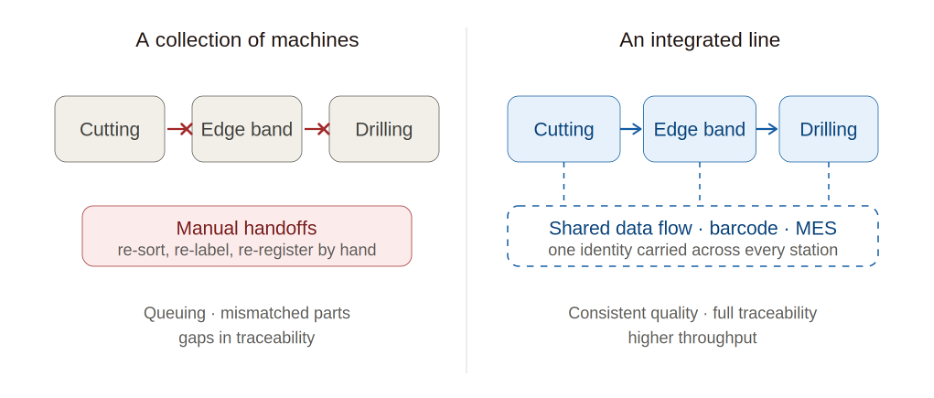
Operated as separate units, panels must be re-registered, re-sorted, and re-identified by hand between each machine, which introduces queuing, mismatched parts, and gaps in traceability.
An integrated line removes those handoffs by binding the machines into one workflow: an order is dismantled into parts by software, each part carries its own identity, and every downstream station applies the correct edge, drilling pattern, and route automatically. What makes this possible is coordination through a shared flow of data and instructions, so that parts and the information describing them move together across the line.
What Does a Fully Integrated Woodworking Production Line Look Like?
A complete panel furniture line is a sequence of modules joined by a shared data backbone, so that each part carries its own machining instructions from one station to the next.
The Module Chain, From Loading to Packing
Loading: Stacked panels are transferred to the roller line by a gantry feeder, reducing manual handling.
Nesting / Cutting: Panels are cut to size and shape, with software optimizing layout for material yield.
Sorting: A sorting system organizes cut parts, so they reach the next station in the correct order.
Edge Banding: Exposed edges are sealed and finished.
Drilling: Holes and grooves are machined from all sides in one setup.
Unloading: Finished parts are removed automatically, and a return line can recirculate panels for high-speed operation.
Packing: Parts are grouped, scanned, and prepared for the next stage of assembly or shipment.
The Three Elements That Connect the Line
Data flow, barcode labelling, and MES are what turn these modules into a single system:
Data flow means each order travels from design software to every machine without re-entry.
Barcode labelling gives each panel a fixed identity, so a part is never confused with another as volume climbs.
MES monitors the whole process in real time and coordinates the stations, allowing panels to be buffered when one station is busy instead of stalling the line.
For the customer, this coordination is what delivers the outcomes that matter: consistent quality on every batch, full traceability from raw panel to finished part, higher throughput because stations are not waiting on manual handoffs, and lower dependence on scarce skilled labor.
It is also the foundation for compliance, since barcode-based traceability supports the record-keeping that high-end markets increasingly expect.
How to Choose a One-Stop Panel Furniture Equipment Supplier
Delivering those three core processes as one solution raises a practical question for buyers: source everything from a single supplier, or integrate machines from several brands?
Single-Source or Multi-Brand Integration: Which Approach Works Better?
Multi-brand integration widens the choice of individual machines, but it also multiplies the interfaces that must be reconciled: differing control systems, data formats, and service contacts.
Sourcing the core process stages from one supplier keeps the control logic, data flow, and after-sales responsibility within a single system, which shortens commissioning and makes ongoing support easier to manage.
In return, more depends on that one partner’s technical breadth and reliability, so evaluating the supplier’s process coverage and track record becomes an important step.
Which Suppliers Offer Complete Nesting + Edge Banding + Six-Side Drilling Factory Solutions?
The suppliers who are able to deliver all three processes as one factory solution are those that manufacture the core machines and unite them under a shared control and data layer. HUAHUA is representative of this category. Developing its machines, control software, and line integration together, HUAHUA supplies the full process from a single source and connects it into one integrated line:
- Nesting and cutting: CNC panel saws and routers for optimized, low-waste panel cutting.
- Edge banding: automatic edge banders with barcode scanning for consistent edge finishing.
- Six-side drilling: CNC six-side drilling machines that complete holes and grooves in one setup.
- Software and control: the self-developed HHM control system and MES that link the stations and monitor production.
- Material handling: gantry loading, sorting, buffering, and automatic return lines that keep parts moving.
Consolidating these under one control and data layer is what allows software-driven order dismantling, and it lifts panel utilization to as high as 95% while reducing dependence on manual labor.

Why Standalone Machines Determine the Strength of a Line for Wood Panel Manufacturing?
A production line performs only to the level of the machines within it. Even a well-engineered line depends on an edge bander that produces clean, tight seams and a drilling head that holds its position over long runs, since a single station that drifts out of tolerance affects the entire workflow. Machine-level reliability and line-level integration are two aspects of one capability, and a supplier that has mastered both is better placed to deliver a dependable line.
HUAHUA offers both standalone machines and full intelligent lines. The individual machines manufactured by HUAHUA are developed and produced in-house, with each manufacturing stage controlled in its own workshops, consistent standards applied across every step, key components tested, and each machine commissioned before delivery. With the advanced production capability, HUAHUA’s factory holds ISO certification, and the machines carry the CE mark. This discipline at the machine level is what allows the same equipment to perform reliably once it is placed inside an integrated line.
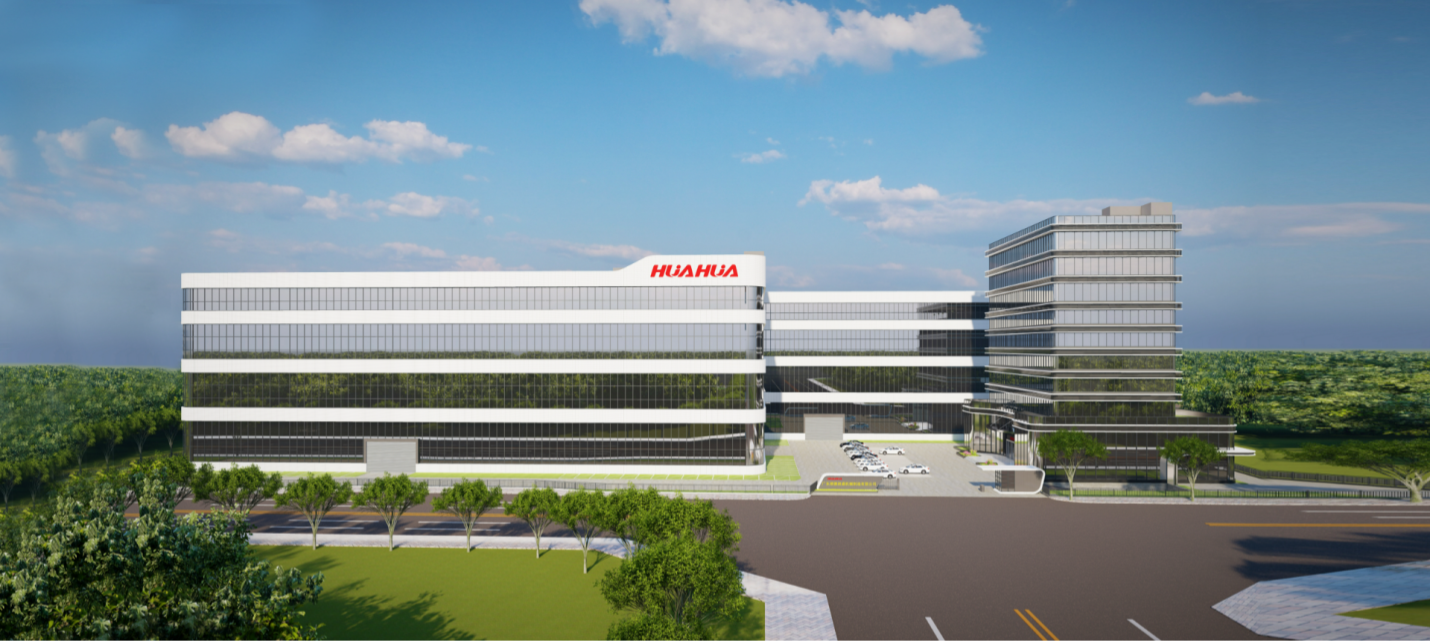
Top Panel Furniture Equipment: HUAHUA’s A8 Smart Line
HUAHUA Furniture Production Line A8 is built for Industry 4.0 operation and bringing the line’s advantages together in one configuration. Order data flows directly from design software into the machines, which automatically dismantle orders and optimise nesting layout; a self-developed HHM control system and MES coordinate the stations and monitor machining in real time; and a panel storage bin, intelligent buffering, and an automatic return line keep parts moving even when a station is momentarily busy.
For the customer, this translates into practical outcomes: panel utilisation reaching as high as 95%, labour requirements reduced by around 60%, and cutting completed in a single pass without edge collapse for cleaner parts. The result is higher, more consistent output from a line designed to run with fewer skilled operators.

Cases of HUAHUA’s Turnkey Panel Furniture Solution
The two projects below illustrate this delivery model in operation:
HUALANGTU Industry 4.0 line (custom furniture): A tailor-made line occupying 1,800 m² over a 90-metre run, combining three cutting machines for optimized nesting, automatic labelling and barcode scanning ahead of edge banding, intelligent buffering and return handling, and three six-side drilling machines online, all coordinated by the self-developed HHM and MES systems. It reaches a top processing speed of 26 meters per minute and a single-day capacity of 350 to 380 large boards.
Exported line to Thailand (2022): A complete panel furniture automatic line covering cutting, edge banding, and drilling, assembled and tested at the factory, accompanied by video-based training, then packed into five containers for delivery to the customer’s warehouse, showing the turnkey model executed across borders.
Conclusion
A Smart Full Line is defined by integration, not by how many machines share a floor: data flow, barcode labelling, and MES are what turn nesting, edge banding, and six-side drilling into one coordinated system, while a turnkey solution carries that line from layout design through to after-sales support. For manufacturers serving premium US and EU customers, this integration is also what makes consistent quality, traceability, and compliance achievable in practice.
HUAHUA brings the two halves of that equation together: dependable single machines and the integrated line built from them, backed by delivered turnkey projects and its A8 reference solution.
Contact us today for a full-line solution tailored to your production needs.