
Manufacturing efficiency is shaped by more than production speed alone. Cutting accuracy, workflow consistency, labor organization, and digital process management all influence the overall performance of a woodworking factory.
As cabinet and furniture markets continue to demand higher product variety and shorter delivery cycles, manufacturers increasingly evaluate whether traditional manual cutting lines can continue to meet business objectives or whether CNC-based production provides greater long-term value.
We help customers compare these production approaches based on practical manufacturing requirements rather than assumptions.
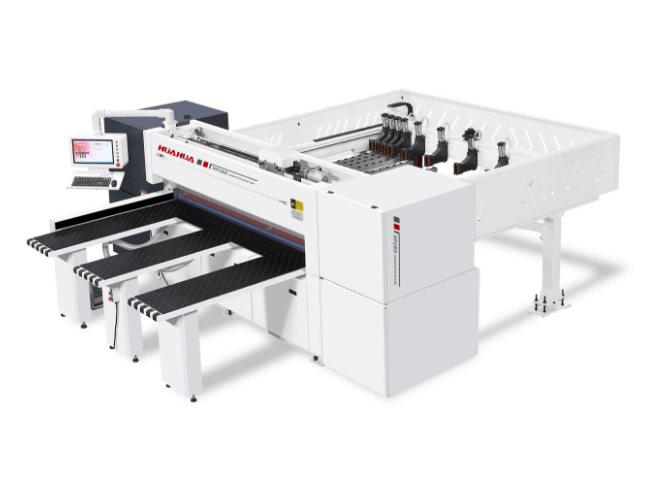
Comparing the Fundamental Production Methods
A CNC woodworking machine performs cutting operations by executing digital machining programs generated from production software. Once production data is imported, the machine follows predefined tool paths to process workpieces with consistent positioning and repeatable machining procedures. The production process relies on digital information rather than manual measurement during each operation.
Manual cutting lines depend primarily on operator experience for measuring, positioning, and processing materials. Skilled personnel can produce quality components, but production consistency is closely connected to workforce proficiency and operating habits. As production complexity increases, maintaining identical machining results across multiple operators may become more challenging.
Neither approach is suitable for every factory. The decision should begin with an objective evaluation of product mix, production volume, and manufacturing goals.
Production Efficiency Across Different Order Types
Factories producing standardized products often establish stable manual workflows that remain effective for relatively simple processing requirements. Operators become familiar with repetitive tasks, allowing production to proceed according to established procedures.
When product diversity expands, woodworking CNC machinery provides greater adaptability because machining programs can be modified digitally without requiring repeated manual layout and measurement. Different product specifications can enter production through software-generated machining files, reducing preparation time between batches.
For manufacturers handling frequent design changes, customized furniture, or mixed production schedules, digital programming helps improve workflow continuity while reducing interruptions associated with manual setup adjustments.
Accuracy and Repeatability in Daily Manufacturing
Dimensional consistency directly affects downstream operations such as edge banding, drilling, assembly, and final installation. Even small cutting deviations may influence overall product quality when multiple components must fit together precisely.
A CNC woodworking machine processes workpieces according to programmed coordinates, allowing repeated production of identical parts throughout successive manufacturing cycles. Digital machining minimizes variation caused by repeated manual positioning, particularly during long production runs.
Manual cutting lines can also achieve acceptable accuracy when operated by experienced technicians. However, maintaining the same level of repeatability across different shifts, operators, or production batches often requires continuous supervision and quality verification.
Manufacturers should therefore evaluate not only cutting precision but also the stability of long-term production consistency.
Labor Requirements and Workforce Management
Labor availability has become an important consideration for many woodworking manufacturers. Recruitment, training, and workforce stability directly influence production planning and operational costs.
With woodworking CNC machinery, operators primarily supervise machine operation, material loading, program selection, and production monitoring. Digital workflows reduce dependence on repeated manual measurement while simplifying standardized operating procedures for different production orders.
Manual cutting lines generally require greater operator involvement throughout each processing stage. Measuring, positioning, cutting, and inspection rely more heavily on individual skills, making workforce experience an essential production resource.
As manufacturers expand production capacity, labor organization often becomes a significant factor when comparing equipment investment options.
Material Utilization and Process Control
Raw material costs remain one of the largest operating expenses in woodworking manufacturing. Improving material utilization therefore contributes directly to production efficiency.
A CNC woodworking machine can work with optimization software that automatically arranges component layouts according to production requirements before machining begins. This digital planning supports efficient sheet utilization while reducing unnecessary manual calculations during production preparation.
Manual cutting processes also allow material optimization through experienced planning, although layout decisions typically rely on operator judgment. As order complexity increases, maintaining consistent optimization across multiple production batches may require additional planning effort.
Factories should compare complete workflow efficiency rather than evaluating material utilization as an isolated indicator.
Supporting Digital Manufacturing Development
Many woodworking manufacturers are gradually adopting digital production management to improve scheduling, traceability, and production coordination across multiple departments.
Modern woodworking CNC machinery can integrate with design software, production management systems, barcode identification, labeling equipment, automatic loading solutions, and downstream machining equipment. Digital information accompanies each workpiece throughout production, helping reduce manual data transfer while supporting production transparency.
Manual cutting lines generally operate as independent production stages with greater reliance on printed drawings and manual communication. Although suitable for certain production environments, they may require additional coordination as manufacturing systems become increasingly interconnected.
Factories planning long-term digital transformation should consider future compatibility when evaluating equipment investments.
Selecting Equipment According to Manufacturing Strategy
Equipment decisions should reflect business development plans rather than temporary production demands. Manufacturers with relatively stable product structures and moderate production requirements may continue operating manual cutting lines effectively when supported by experienced personnel and established workflows.
Companies expanding customized production, increasing automation, or pursuing digital manufacturing often benefit from the flexibility provided by CNC woodworking machine technology. Digital programming, integrated process control, and scalable automation help support evolving production requirements without fundamentally changing manufacturing principles.
Instead of viewing manual and CNC production as competing concepts, we encourage customers to evaluate how each solution aligns with production scale, product diversity, labor resources, and future investment planning.
HUAHUA CNC Supports Sustainable Woodworking Manufacturing
Selecting woodworking equipment requires careful analysis of production processes, operational objectives, and long-term manufacturing strategy. At HUAHUA CNC, we focus on delivering data-backed, practical solutions that help customers establish efficient and reliable woodworking production systems rather than promoting equipment through generalized comparisons.
With 23 years of specialized woodworking machinery R&D and manufacturing experience, a 100,000m2 integrated factory, an annual output of 8,500 sets of CNC equipment, over 60 technical patents and a 400+ professional engineering team, our product portfolio covers full-spectrum integrated woodworking manufacturing solutions tailored for furniture, cabinet, and panel processing applications.
And we serve more than 5,000 stable clients across 50+ countries worldwide. By combining equipment engineering, intelligent workflow planning, and big-data cloud production scheduling, our customized smart production lines have delivered verifiable operational gains for manufacturers: cutting labor costs by 60% and lifting raw panel utilization rate up to 95%, significantly boosting ROI for panel furniture factories.