
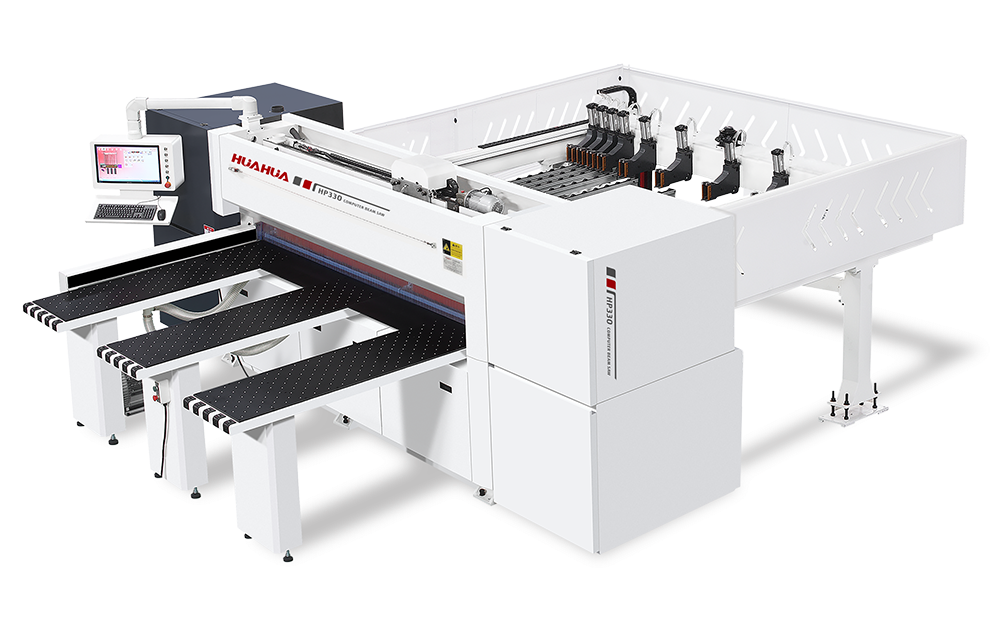
Panel cutting systems play a decisive role in modern furniture production efficiency, where precision, speed, and stability directly influence output quality. The comparison between an automated panel saw and a sliding table saw is especially important for manufacturers evaluating upgrading paths in panel processing. At HUAHUA CNC, we specialize in advanced woodworking solutions including CNC panel saw systems, CNC wood drilling machines, automatic edge banding machines, CNC wood routers, and complete furniture production lines, helping global clients optimize cutting performance and productivity.
Structural Differences Between Automated Panel Saw and Sliding Table Saw
An automated panel saw, often referred to as a beam saw machine, is designed for high-volume, fully automated cutting operations. It integrates servo-driven systems, automatic feeding, and precision positioning to handle large batches of panels efficiently. In contrast, a sliding table saw relies heavily on manual operation, where the operator pushes the panel across a sliding table to complete cutting tasks.
In real production environments, the beam saw machine provides consistent accuracy and repeatability, while a sliding table saw depends more on operator skill. For large-scale panel furniture factories, the automated panel saw becomes a more efficient choice due to reduced manual handling and improved cutting stability.
Performance and Efficiency in Industrial Applications
The automated panel saw delivers significantly higher productivity compared to traditional sliding table saws. For example, HUAHUA CNC’s beam saw machine model HP280 supports a maximum cutting length of 2800mm and features a machine size of 6060×5240×2060mm, making it suitable for high-capacity production environments.
Its pneumatic clamping system adopts an industry-leading two-finger structure, where panels are securely clamped by an air cylinder before feeding. This design ensures that the beam saw machine maintains cutting accuracy while preventing damage to the panel surface during handling. Compared to manual clamping on a sliding table saw, the automated panel saw significantly reduces errors and improves surface quality consistency.
Drive System and Cutting Stability Advantages
Another key advantage of the automated panel saw is its advanced drive system. The CNC beam saw from HUAHUA CNC is equipped with a saw carriage driven as you can see, HUAHUA CNC’s beam saw machine model HP280 equipped with 2kw servo motor, saw carrigae power reducer, gear reducer three-phase asynchronous motor, make sure high efficiency and stable cutting. This configuration ensures stable and high-efficiency cutting performance even under continuous operation.
By comparison, sliding table saws lack automated motion control, which limits their cutting speed and consistency. The beam saw machine provides smoother acceleration and deceleration, reducing vibration and improving overall precision in mass production environments. At HUAHUA CNC, we integrate these engineering advantages to ensure every automated panel saw delivers industrial-grade reliability.
Choosing the Right Solution for Scalable Production
For manufacturers aiming to scale production capacity, the automated panel saw offers clear advantages in speed, precision, and labor efficiency. Sliding table saws may still serve small workshops or low-volume production, but they cannot match the performance of a beam saw machine in industrial panel processing.
At HUAHUA CNC, we combine advanced engineering with strict quality control across every CNC panel saw system we produce. With rigorous inspections on every component, cooperation with reliable suppliers, and a fully managed ERP system, we ensure stable supply and consistent quality. Our controlled manufacturing processes across all workshops further guarantee that every beam saw machine delivers long-term performance and precision for global woodworking applications.