
Modern panel processing requires equipment that matches production scale, material characteristics, and automation requirements. We believe selecting the appropriate machine category is one of the most important decisions for manufacturers seeking consistent product quality and efficient workflow management.
Different types of CNC panel saw equipment are designed to address different production environments, from small-batch customization to continuous industrial manufacturing. Understanding these categories helps buyers choose machinery that supports both current operations and future production planning.
Practical Sawing Alternatives for Manufacturers with Limited Output
Workshops handling modest output levels can still benefit from manual and semi‑automatic panel saws as viable processing solutions. Such machinery finds frequent application among fabricators working with small‑batch wood‑based panel stock or delivering heavily custom‑tailored orders.
Reliance on operator expertise defines positioning and material‑feeding workflows for purely manual set‑ups. Semi‑automatic variants boost throughput with motor‑driven motion functions and streamlined positioning hardware; they cut down on tedious manual operations without sacrificing versatile handling capabilities.
Even though these systems demand modest upfront capital outlay, uniform output quality hinges heavily on the operator’s proficiency. Growing production throughput will frequently expose bottlenecks in processing speed, replication accuracy and labour‑use efficiency for fabricators relying on this equipment category.
When planning for sustained business expansion, enterprises ought to weigh manual‑type machinery against projected future manufacturing demands, instead of focusing solely on short‑term procurement expenses.
Reduced Manual Intervention in Computer‑Controlled Panel Saw Workflows
Growing levels of automation within furniture production have elevated CNC‑driven machinery to the top choice for mid‑ and large‑scale manufacturing plants. Cutting routines governed by computer algorithms deliver superior repeat performance and lessen human involvement across every stage of fabrication.
Digital oversight of cutting layouts is made possible via the CNC platform, which streamlines production coordination across varied product batches. Since machine motion runs off pre‑programmed commands instead of hands‑on tweaking, operators can achieve far more uniform output when fulfilling manufacturing orders.
Enhanced stability in material processing represents another key benefit brought by automation. Regulated positioning, feeding and cutting cycles preserve precise component dimensions, and these capabilities also sustain non‑stop production workflows.
Producers specialising in cabinetry, wardrobes, office furnishings and custom interior finishes gain tangible benefits from CNC technology. It seamlessly merges sawing workflows into comprehensive digital manufacturing ecosystems.
Industrial Capacity of the Panel Saw Machine
High-volume factories require equipment designed for continuous operation instead of occasional production. Industrial panel saws focus not only on cutting performance but also on workflow integration, mechanical stability, and automated material movement.
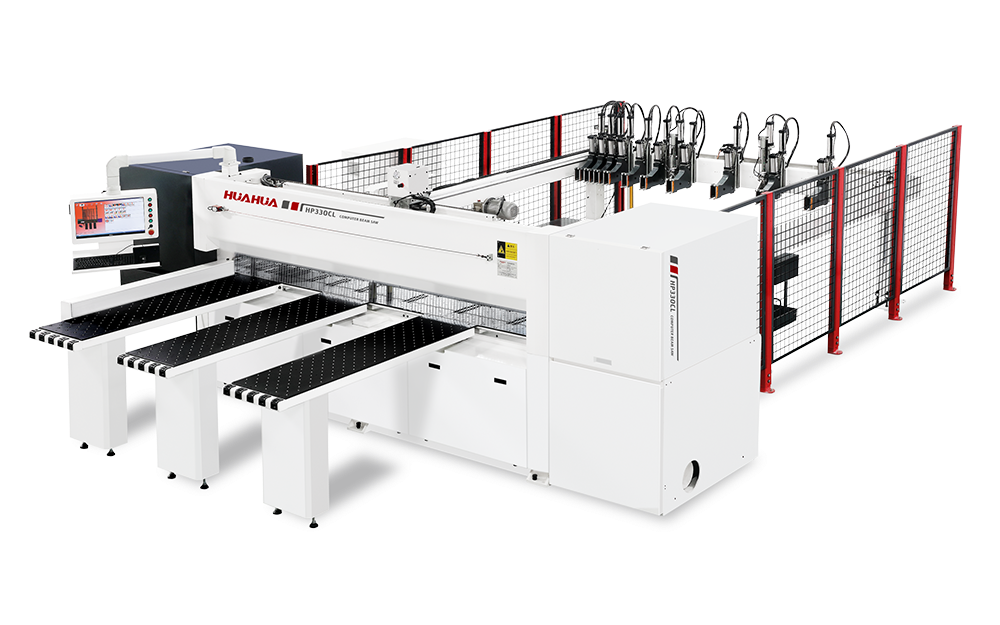
The HUAHUA CNC HP330CL Automatic Panel Saw Machine is developed for industrial wood panel processing. Its design combines automatic feeding with computer-controlled cutting functions to support efficient production organization across furniture manufacturing environments.
The machine adopts a heavy-duty welded steel structure that undergoes processing before final assembly, helping maintain structural stability during continuous operation. Stable machine construction supports repeatable cutting quality throughout extended production cycles.
Its automatic feeding system reduces unnecessary manual handling while improving production continuity. By coordinating feeding and cutting operations, manufacturers can organize production more efficiently and reduce interruptions between workpieces.
Bridging Machine Operation with Digital‑Factory Management
Production efficiency can no longer be measured by mechanical capability alone. Control systems carry equal significance, as they link on‑site machine execution to production scheduling and digital factory administration.
Built around a production‑focused industrial PC control platform, the HP330CL streamlines workflows for shop‑floor staff through its user‑friendly interface. This system enables straightforward management of cutting programs alongside simplified day‑to‑day machine operation.
Repetitive programming tasks can be largely eliminated through digital‑centric production management, allowing manufacturers to arrange diverse customer orders with greater efficiency. Software‑aided workflows deliver better process coordination whenever production runs call for multiple panel sizes and specifications.
Equipment upkeep also benefits from robust industrial control systems, which supply real‑time operational data and built‑in diagnostic functions. Clear visibility into machine conditions lets maintenance teams minimise avoidable downtime and keep production running continuously.
Seamless compatibility with factory‑level management software brings additional value to operators building automated furniture production lines. Unified data flow fosters better information exchange across design, planning and manufacturing departments.
Material Processing Flexibility of the Panel Saw Machine
Industrial manufacturers rarely process only one material category. Production often includes MDF, particle board, plywood, laminated boards, decorative panels, and other engineered wood products depending on customer requirements.
Equipment flexibility therefore becomes an important purchasing consideration. Machines capable of processing different panel materials allow manufacturers to respond more effectively to changing market demand without investing in multiple specialized cutting systems.
The HP330CL is designed for woodworking panel processing applications commonly found in furniture manufacturing. Its automated cutting process supports efficient handling of production tasks involving different board specifications while maintaining stable operation.
Material flexibility also improves factory scheduling. Manufacturers can organize production according to customer orders instead of separating work across multiple dedicated machines, reducing unnecessary material transfers within the workshop.
When evaluating industrial equipment, buyers should consider not only cutting capability but also compatibility with their complete production process, including loading, optimization software, labeling, and downstream manufacturing operations.
Selecting the Right Machine for Long-Term Manufacturing Success
Different production environments require different equipment strategies. Small workshops may prioritize operational flexibility, while high-volume manufacturers often focus on automation, production consistency, and system integration. Selecting the appropriate machine category should always begin with actual production requirements rather than isolated technical specifications.
At HUAHUA CNC, we develop woodworking machinery that supports modern furniture manufacturing through practical engineering and reliable automation. Our product portfolio includes panel saws, edge banding machines, CNC drilling machines, CNC machining centers, and integrated production solutions designed for industrial applications.
The HP330CL Automatic Panel Saw Machine reflects our commitment to stable machine construction, automated material handling, and intelligent production control. By combining these capabilities within a manufacturing-oriented design, we help customers improve production efficiency while supporting consistent panel processing quality. As HUAHUA CNC continues to work with furniture manufacturers worldwide, we remain focused on providing equipment that matches real industrial production needs and supports sustainable manufacturing development.